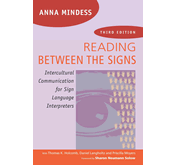
Tom:
Tom’s book is here!
Black American Sign Language
Anna:
A fascinating article in the Washington Post details unique aspects of Black American Sign Language. Because of segregated schools Black ASL diverged from the sign language used in white deaf schools after the switch to oralism in the predominately white deaf schools. Ceil Lucas, one of the co-authors and a professor of linguistics at Gallaudet, says, “Black ASL could be considered the purer of the two forms, closer in some ways to the system that Thomas Hopkins Gallaudet promulgated when he founded the first U.S. school for the deaf — known at the time as the American Asylum for Deaf Mutes — in Hartford, Conn., in 1817.”
Lucas and three other professors have published a book and DVD called The Hidden Treasure of ASL.
Here’s some pictures from the book, via the Washington Post. Check it out.

Artwork of 18 Deaf Artists featured in the new textbook
Tom:
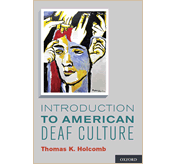
Along with Nancy Rouke’s vibrant expressionist artwork on the cover of the new textbook, Introduction to American Deaf Culture, 17 other Deaf artists’ works are also prominently featured throughout the book. They include: Iris Aranda (Two People and a Hand), Chuck Baird (Tyger, Tyger), David Call (Awakening), Matt Daigle (That Deaf Guy: Poop), Susan Dupor (The Family Dog), Maureen Klusza (The Greatest Irony), Leon Lim (Killing My Deafness), Tony “Mac” Gregor (A Tribute to ‘Fingershell’ painting by Chuck Baird), Betty Miller (Ameslan Prohibited), Warren Miller (Embrace), Mary Rappazzo (Celebrating Deaf Culture), Roy Ricci (Two Eyes), Shawn Richardson (Terp Remote Control), Ann Silver (A Century of Difference), Scott Upton (Butterfly), Mar Valdez (Set Me Free), and Larry Yanez (I Love You). While some of these works are well known to the Deaf community, others are relatively new. Each chapter begins with one of these art pieces, corresponding to the subject being discussed.
Oxford just posted on their website, Introduction to American Deaf Culture’s official page, with ordering information. It will be released October, 2012.
“Why do you ask?” – Web TV Channel Highlights Deaf/Hearing Cultural Differences
Anna:
Here’s a new web TV channel that highlights Deaf and hearing cultural differences. First installment: a Deaf man asks too many “personal questions” to a hearing woman he just met. It’s in “international sign” with English captions.
http://www.h3.tv/shows.php?show_id=3
(If you look carefully at the credits, you’ll see they were inspired by our materials. Nice.)
ASL / English Bilingual Preschool Program Gets Results
Tom:
One of the strongest arguments in favor of the ASL/English bilingual philosophy (as opposed to the auditory/verbal approach) is the relative ease of developing literacy skills among deaf children. Yet, people often wonder how deaf children, whose first language is ASL, will learn to read and write. This video shows how pre-school teachers in an ASL/English bilingual program help build bridges between ASL and English that positively impact deaf children’s overall linguistic development.
New Release Date for Introduction to American Deaf Culture
Tom:
Just heard from my editor at Oxford University Press and October is now the new release date for the textbook, Introduction to American Deaf Culture, which will be just in time for instructors to place orders for their spring semester Deaf culture classes. The work has begun on the book’s cover, which will feature one of Nancy Rourke’s expressionist paintings. Nancy Rourke is emerging as one of the most dynamic contemporary Deaf artists. Her work illustrates the Deafhood journey in which many Deaf people embark on a search for a comfortable identity. She also features illustrations of well-known figures in the Deaf community in her artwork. To view her work, check out her website at www.nancyrourke.com.

Link to “Love being Deaf” by Chad Taylor
Tom:
Here is an articulate young man’s reflections on what it means to be Deaf – and proud to add that he happens to be my son-in-law.
http://blog.chadwtaylor.com/post/24206199845/love-being-deaf?og=1
The Future is Already Here — in Montana
Tom:
I just returned from Great Falls, Montana where I gave a workshop on how Deaf culture can benefit families with deaf children. While there, I learned that almost all deaf children in Montana receive cochlear implants. The procedures are now so routine, that there is no need for specialized cochlear implant centers. Instead, specially trained ENT physicians perform implant surgeries at regular hospitals.
Most of these children are mainstreamed in local schools with the support of sign language interpreters. Every year, their families travel to Great Falls, where the school for the deaf is located, to participate in a Family Learning Vacation. Many students look forward to the annual event as it provides them with rare opportunities to meet and interact with others just like themselves. Parents get to network with other parents in addition to learning from experts in the field and Deaf adults about raising deaf children.
My message to them was that Deaf Culture is full of solutions to help create an environment that would allow for fuller integration of deaf children in their families. Since Deaf people and their families have “been there and done that” for decades, I encouraged workshop participants to tap the wealth of these experiences.
My presentation was based on the information I have gathered over the past twenty years from teaching in the Deaf Studies Department of Ohlone College. I have taught several different Deaf culture courses, including one that is exclusively for Deaf students. In this course, Deaf students often share their frustrations and the challenges of living in a hearing household where they frequently feel left out. This feeling of exclusion is common even among students with cochlear implants. These students have told me that my class was helpful in finding solutions related to defining their identities and their attempts to be more fully included in their families. With cochlear implants becoming more widespread, and deaf children and their families struggling to find solutions, I hope my new textbook, Introduction to American Deaf Culture, will provide them with the information and support they need to become a better integrated family. I believe this book is timely because the situation in Montana is becoming the norm for the rest of the United States.
Deaf Culture in Action at Deaf-Owned Restaurant, Mozzeria
Anna:
As a sign language interpreter, I became interested in the study of world cultures because that field shed so much light on the interactions between Deaf and hearing people that I witnessed — and interpreted — daily. The cultural perspective seemed to answer many questions about why certain behaviors were often misunderstood by members of each group. After writing my book, I traveled around the country training other interpreters about how to adopt this intercultural perspective in their work. That’s when it struck me that many Americans don’t pay very much attention to their own cultural identity. I would often hear interpreters say, “Oh, I don’t have a culture, I’m just normal.”
I realized that besides teaching sign language interpreters about the importance of culture, I also wanted to introduce the cultural perspective to a broader audience. That inspired me to write about the intersection of food and culture. In articles for local magazines and my blog, I try to expose readers to dishes and foodways from a variety of cultures – such as “lucky” New Years foods from around the world, Singaporean sweets, and cultures where people prefer to eat with their hands.
With the recent opening of Mozzeria, San Francisco’s first Deaf-owned restaurant, I had a unique opportunity to mesh my two worlds. Here is an article I just wrote for KQED.org’s Bay Area Bites blog. It includes a video interview (in ASL) with the owners, Melody and Russell Stein and several comments about Deaf culture.