RSS Feed

FREE Resource for ASL, Deaf Culture and Interpreting Instructors

FREE Resource for ASL, Deaf Culture and Interpreting Instructors
RBS Workbook now available Free

RBS Workbook now available Free

Anna:
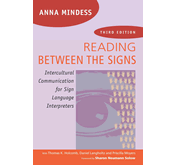
In conjunction with the October release of a new 3rd edition of my book Reading Between the Signs, the  publisher and I decided to make available as a FREE Ebook, the companion Workbook which was published several years ago.

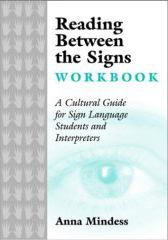
The Workbook contains 22 exercises that help readers develop an intercultural perspective, undertake cultural self-examination and illuminate major contrasts between American Deaf and hearing cultures. Activities may be done either alone or in small groups. It complements all 3 editions of the book. Here is the link to download the whole book:

http://www.nicholasbrealey.com/Reading%20Between%20the%20Signs%20Workbook.pdf

Or you may get a FREE Kindle Version from Amazon 

Here is a sample exercise called: YOUR POLITE IS DIFFERENT FROM MY POLITE

Directions: Read the statements below and decide if they describe an attitude more often found in mainstream American (hearing) culture or in American Deaf culture. Put an H (for hearing) or a D (for Deaf ) in the spaces provided.

______ 1. Sharing personal information benefits us all.

______ 2. The “grapevine” shows people care about each other.

______ 3. Name-dropping is pretentious.

______ 4. Graphic descriptions of bodily functions and surgical procedures often make people uncomfortable.

______ 5. Describing your ties to well-known community members can demonstrate your trustworthiness.

______ 6. Stories regarding your own and others’ illnesses and medical treatments are important to share.

______ 7. Passing along the latest news about mutual friends is considered “talking behind their backs.”

______ 8. Softening a critical comment often makes it easier for the other person to accept.

______ 9. If you can’t say something nice, don’t say anything at all.

_____ 10. Some topics (such as money and bathroom habits) are off-limits in polite society.

_____ 11. You owe it to your friends to inform them if a new hairstyle is unbecoming.

_____ 12. If you have a criticism, tell it straight.

Draw lines between pairs of sentences above that express opposite messages.You should end up with six pairs.

Remember that these are generalizations of tendencies within each group.Individual members of either group may subscribe to the attitude expressed by a particular statement to a greater or lesser degree. (Suggested answers to this exercise appear in book on page 120.)


Please share this free resource with any ASL, Deaf Culture or Interpreting instructors that you know. Thanks!!

Paddy Ladd Unveils Outline of New Book

Anna:

Last week, I joined the warm crowd who welcomed Dr. Paddy Ladd at the California School for the Deaf in Fremont, California, where he treated us to a sneak preview of his new book that challenges the prevailing methods in Deaf Education, which have been invented and promoted by hearing people.

Dr. Paddy Ladd at CSD Fremont, October 8, 2013

Dr. Paddy Ladd at CSD Fremont, October 8, 2013

His presentation, co-sponsored by CSD and the Deafhood Foundation, A Final Frontier: Can Deafhood Pedagogies Revolutionize Deaf Education? was live-streamed by the Deafhood Foundation, which promises to make the video available at a later date, but Dr. Ladd’s Power Point slides can be found on their website now.

Ladd provocatively engaged the audience with, “We’ve been colonized!” and continued, “Books on Deaf education are written by hearing people, and our perspective is not incorporated in the curriculum. This has the consequence that Deaf children show poor results. Then the blame is placed on the parents, on the child, on sign language–everywhere other than where it belongs.”

“Why not trust those who have been successfully educating Deaf children for generations,” Dr. Ladd proposed, namely Deaf educators. This topic, which Dr. Ladd has been researching for many years, is the focus of his new book, a 300+ page volume he hopes to have finished next year, tentatively entitled,

SEEING THROUGH NEW EYES: Deaf Pedagogies and the Unrecognized Curriculum.

Dr. Ladd acknowledged the inspiration and support received from Dr. Hank Klopping, retired CSD Superintendent, and CSD teachers Laura Peterson and Dee Kennedy. He praised CSD’s Bilingual-Bicultural approach and its excellent teachers. He also recognized his co-researcher on the studies that form the basis for his new book, Dr. Donna West, a hearing teacher, who “helped him see things he otherwise would have missed.”

Now that his Department of Deaf Studies at the University of Bristol is closed despite a public campaign to save it, Ladd cited the upside of having more time to write and finish this book.

Against a background of “Cultural Holism,” Ladd outlined six overlapping Developmental Stages, from ages 0-5 “Developing the Cognitive Engine” to ages 7-18 “Teaching how to live in Deaf and Hearing worlds.” One cultural point I especially appreciated was his suggestion of contextualizing “Deaf bluntness” or “Straight Talk” as it shows Deaf children that you care and that they are loved.”

His book draws parallels with other indigenous peoples and minority communities such Maori, African-American and Native American and he gave special recognition to Dr. Marie Baptiste of Canada, her work with Indigenous Knowledge and her assertion that cognitive imperialism by “others” inflicts “soul wounds.”

The anticipation is high for Ladd’s new book after the huge impact his first book Understanding Deaf Culture:In Search of Deafhood has made around the world.

Deaf Way II panel, 2002, with L to R: Thomas Holcomb, Theresa Smith, Anna Mindess, Ben Bahan, Paddy Ladd.

Deaf Way II panel, with L to R: Thomas Holcomb, Theresa Smith, Anna Mindess, Ben Bahan, Paddy Ladd.

A personal note: I first met Paddy Ladd in 2000 in Amsterdam at the TISLR conference (Theoretical Issues in Sign Language Research) where we both presented. My book had just come out and he was still working on his. We connected against the backdrop of extremely theoretical papers because both of us hoped that our work would result in practical changes. Then in 2002, at Deaf Way II, Tom and I were honored to be invited by Paddy to join him in a panel he chaired called Researching Deaf Culture, Liberating Deaf Community (with Ben Bahan and Theresa Smith). Here is a very old picture of us all.

And I just found that Gallaudet recently made available online a video of the entire panel presentation at:

Part 1: http://videocatalog.gallaudet.edu/?video=15318

Part 2: http://videocatalog.gallaudet.edu/?video=15319

Please be advised that Paddy signs in BSL (the rest of us in ASL). The video includes voice interpretation, but no captions.

My Enriching Encounters with Japanese Deaf People

ASL class for Deaf Japanese people, near Osaka, Japan

Anna visits ASL class for Deaf Japanese people, near Osaka, Japan

Anna:

I recently returned from a trip to Kyoto and Osaka Japan, where I had food adventures like this lesson from a sushi fanatic. Also with the help of connections, I got the chance to meet and chat with some deaf people in Japan. Since JSL is very different from ASL, it was lucky for me that many Japanese deaf people are motivated to study ASL because they enjoy traveling and socializing with foreigners. I got invited to visit a few classes in Kyoto and Osaka.

Natsuko and Maru co-teach an ASL classes at night (while teaching JSL by day). Coincidentally, they had met Tom six months ago when they visited Ohlone College to observe teaching methods. Their students were excited to have me visit and asked me to spend the first part of the class introducing myself and my work. They seemed especially interested when I told them that I work mostly in the courtroom doing legal interpreting. The situation in Japan is not what deaf people enjoy in the U.S. So there is not yet legal training offered to JSL interpreters. I stressed the importance of having interpreters with legal training and also told them that working with CDIs (Certified Deaf Interpreters) is often the most effective approach in court. I suggested that if they are in a position to set up interpreting protocols for court, that they begin by having deaf interpreters be part of the process, instead of trying to add them in later, as is the case here.

After that discussion, Natsuko told the class to break up into two teams to play a game. I thought I would just sit and observe, but it turned out that the object of this guessing game was to make ME guess the answers. Each team turned over pictures that Natsuko had prepared and had 2 minutes to huddle and decide on 3 ASL signs to convey the subject of the picture to me. (Of course they were not allowed to use a sign for the name of the object). The first round, the signs they gave me were JAPAN, FAMOUS and HIGH. Hmmm…it took me a minute. I couldn’t think of a Japanese counterpart to the iconic Eiffel Tower or Leaning Tower of Pisa. Finally, I had a thought. “Is it Mount Fuji?” I asked, doubtfully. The team exploded with cheers and high 5’s. Another round produced: JAPAN SPORT FAT. “Sumo wrestling!” I answered confidently. Again, high 5’s and cheers. I had a blast because I love games and I realized this one was also a test of my knowledge of Japanese Culture. After the game, with a close score of 4 to 5, we all went out to an izakaya to drink and eat!

Another evening, I met Danny Gong, an American CODA who now lives in Japan and teaches ASL with DEAF JAPAN . He also makes cute videos, like this one comparing the ASL and JSL signs for SUMMER. Culturally speaking, it makes total sense that the JSL sign looks like a waving fan. (Boy, was it hot there the last few weeks too!)

I also was invited to present a lecture at Kansai Gaidai University for a class called Deaf World Japan, taught by Professor Steven Federowicz who has a blog called Visual Anthropology of Japan. His students are mostly American foreign exchange students, but also a few from other countries. Another day, I came back to his class to see a deaf woman, Ms. Morimoto, present. She told the story of her life with the challenge of dealing with an oral education, trying to learn to speak and lip-read Japanese, the physical punishments students endured at school when they were caught signing and her delight in using JSL.

It seems that there are divisions in the Deaf communities in Japan, some pushing for Signed Japanese, while others advocating for JSL. To demonstrate the difference to these beginning learners of JSL, Ms. Morimoto did a clever demonstration. She first showed the generic sign for EAT in JSL, in which one hand “holds the bowl” and the other uses two fingers to represent the action of bringing chopsticks from the bowl to the mouth.

Okinomiyaki, sushi and takoyaki - mmm...

Okinomiyaki, sushi and takoyaki – mmm…

Then she held up drawings of other specific foods and asked students to show how they would eat a SANDWICH, OKINOMIYAKI (a large vegetable pancake that one slices one piece at a time), SUSHI or TAKOYAKI (a snack of grilled octopus made into a ball that is speared with a toothpick to eat.) Of course, in JSL, EATING each of these foods would require a different sign, as the action required does not resemble bringing rice to the mouth with chopsticks. But, said Ms. Morimoto, Signed Japanese would use the generic sign for EAT + the noun form of each of these foods. I thought this was a great example and also tied back into my fascination with Japanese food.

Announcing New Resources for Instructors – sample curriculum and PowerPoint

Posted on

Tom and Anna:

We want to make it easy for instructors to use our materials and have just added a new feature to Deaf Culture THAT: a RESOURCE page where we will be adding items to give you ideas and support in making the most of our books and  DVDs.

To start, Tom has contributed a Sample Curriculum for an entire semester of a Deaf Culture class, utilizing his textbook, Introduction to American Deaf Culture and our Workbook and DVD set, A SIGN OF RESPECT.  He outlines 15 weeks of reading and homework assignments for a complete Deaf Culture class.

Anna is offering a Power Point Presentation entitled, CULTURAL SENSITIVITY FOR ASL STUDENTS that she presented at a national ASLTA Conference. It suggests exercises from her READING BETWEEN THE SIGNS WORKBOOK  and our DVD, SEE WHAT I MEAN.

We plan to add more resources soon and would welcome your suggestions. If you have used any of our materials in a successful class experience, please let us know and we may feature your ideas.

Please check out our new RESOURCES FOR INSTRUCTORS page.

Mourning the loss, celebrating the spirit of Dr. Nathie Marbury

Posted on

Tom:

We have lost a giant in the Deaf community.  Dr. Nathie Marbury was much loved and well respected by her friends, colleagues and students.   She was an inspiration to many, especially those in the Black community, and in the fields of ASL teaching, Deaf theatre, and Deaf education .  She also was a pioneer in analyzing and documenting Deaf culture.  We will miss her dearly.
 
For a brief biographical sketch of her life, click on this website..
 
 
To view her performance of “To Dream The impossible Dream”, click on this website
 
 
To join her facebook page, click on this website.
 
 
To view one of her discussions on the differences between deaf and hearing cultures, click on this website..  
 

Deaf and Jewish: A Deaf Rabbi’s Eloquent Story

Posted on

Anna:

Fascinating article by Rabbi Yehoshua Soudakoff, a Deaf man from a Deaf family who realized his dream of studying at a yeshiva and becoming a rabbi, despite facing many challenges along the way. (Note: the article is sprinkled with Yiddish words, but even if you don’t understand them, Rabbi Soudakoff’s eloquence and spirit are crystal clear).

Hear Me Out article

Meet Tom Holcomb at Upcoming Book Signing Events

Posted on

Due to excitement about Tom’s long-awaited and unique contribution, his book, Introduction to American Deaf Culture, he is starting a series of lectures and book signings. The first three take place in Northern California and Seattle, Washington. Come and meet Tom and get a signed copy of his new book. Will update more book signing events as they become finalized.

Tom’s lecture and book signing schedule

1) Saturday April 13, 2:00 – 4:00pm  – San Francisco Public Library

Lecture and Book Signing

Deaf Culture: An Obsolete Concept or A Timeless Solution?

SF Main Library – Koret Auditorium – 100 Larkin St., San Francisco, CA

For more info: http://sfpl.org/index.php?pg=1012068201

2) Friday May 3, 2013, 6:45 – 8:30 pm – University of Washington, Seattle, WA

Lecture and Book Signing

Deaf Culture: An Obsolete Concept or A Timeless Solution?

For more info: http://www.scccaslconsortium.org/EventForms/ThomasHolcomb.pdf

3) Friday May 10, 2013, 6:00 – 8:00pm – Deaf Community Center, San Leandro, CA

Presentation and Book signing

DCC, 1550 San Leandro Blvd., San Leandro, CA

For more info: http://www.dcara.org/index.php?option=com_jevents&task=icalrepeat.detail&evid=1972&Itemid=12&year=2013&month=05&day=10&uid=37ef842f69f9f730259a02ac5eca3ae2


Reporting Bathroom Behavior – Is that really “Deaf Culture”?

Posted on

Tom:

These days on YouTube, you can find many attempts to explain differences between Deaf culture and hearing culture.  One good example is the work of  a CODA named Will (CODA8810).  He provides several episodes, which although exaggerated, illustrate how Deaf people can behave very differently from hearing people. One of his scenes depicts graphically the openness and the etiquette related to information sharing regarding what goes on in the bathroom. This kind of openness has long been the subject of debates among Deaf people as to the appropriateness of such disclosures.  You need to watch Will’s 3 short scenes on YouTube: to see for yourself. So, does this truly fit the definition of Deaf Culture?

As discussed in the book Introduction to American Deaf Culture, cultural behaviors can be categorized into three categories – explicit, implicit, and emblematic.  Some behaviors are explicitly regulated through laws or policies.  For example, the government determines the legal age for getting a driver’s license or drinking alcohol beverages.  The legal age for these actions varies from culture to culture.  Other behaviors are implicitly understood.  Rather than being regulated by laws or policies, they are generally accepted and practiced by the community members.  For example, tipping rules also vary from culture to culture.  Here in American restaurants, a tip of 15% to 20% of the bill is expected, but not mandated by law.  The final category is where behaviors are emblematic of the culture but not necessarily practiced by most members of the community.  For example, foul language is often used in American movies, giving an impression to people throughout the world that such behavior is typical of Americans.  While most Americans may not themselves swear as much as certain characters in movies, foul language has become emblematic of American culture.

In the case of Deaf culture, etiquette associated with information sharing about bathroom behavior or personal ailments has been long debated among Deaf people.  Letting others know where you are going when you leave the room is expected of Deaf people, even if the bathroom is your destination.  Adding a vivid description of what transpired in the bathroom is not.  Yet, it is not that unusual to be at the receiving end of a detailed description of a difficult bowel movement or colorful vomit.  This openness can be considered emblematic of Deaf culture…that is it is not customary or expected of Deaf people to be graphic, yet such descriptions are not that unusual within the Deaf community.  CODA Will makes  this point in his another YouTube presentation —  What do you think?

Food and Deaf Culture: what’s the connection?

Posted on

Anna:

I have always been fascinated by different cultures and the variety of perspectives they provide. After working as an ASL interpreter for many years, I wanted to share with others my study of  intercultural communication and its connection to Deaf culture. I began by writing articles and eventually a book. Tom Holcomb was a key collaborator on my book and we started creating DVDs together to illustrate the power of cultural differences to a wider audience.

Now I have added another profession: food writer. Again, I want to share my discoveries about food and culture and began by writing a blog, then magazine and online articles. Recently I’ve also co-created videos.

Here is an article from KQED Bay Area Bites that combines all my interests. Click on link:

Deaf Foodies Savor Gourmet Ghetto Tasting Tour in Sign Language and you’ll see it has a lively video.

Anna interpreting food tour in Berkeley, photo courtesy of Ken Arcia

Anna interpreting food tour in Berkeley, photo courtesy of Ken Arcia


Cultural Detective Highlights Deaf Culture

Posted on

Anna:

Cultural Detective: Deaf Culture Value Lens

Cultural Detective: Deaf Culture Value Lens

Tom and I are proud to be among the distinguished authors in the Cultural Detective series, which provides online tools to develop intercultural sensitivity and includes over 50 culture-specific packages from Argentina to New Zealand. In Cultural Detective: Deaf Culture, a “Value Lens” illustrates the values important in Deaf Culture, including Collaboration, Shared Information, Straight Talk and Group Orientation. Then through several critical incident stories we see how a clash of value can lead to misunderstandings. Strategies for bridging these gaps are taught.

A recent post on Cultural Detective’s blog highlighted issues in Deaf Culture in the wake of the controversy about ASL interpreter Lydia Callis. Read the blog post here. What do you think about the post-Hurricane Sandy comedy shows poking fun at the expressive interpretation of Ms. Callis?